Industrial Welding Electrodes: Selection Guide for Different Metals
Electrode Selection in Welding
Electrode selection is one of the most important decisions in any welding job. Using the wrong one can result in problems such as poor fusion, cracking, excessive spatter, or joints that fail under service loads. Whereas using the right one means the weld becomes predictable, consistent, and fit for the application.
The challenge is that different metals behave very differently under the arc. What works on mild steel causes defects on stainless steel. And what works for aluminium doesn’t for cast iron.
This guide covers how to match welding electrodes to the metal being welded and what to consider before making that call.
What Determines Electrode Selection
Before getting into specific metals, five factors shape every electrode decision:
- Base metal composition: The chemistry of what’s being welded determines the filler chemistry required.
- Required mechanical properties: Strength, toughness, and ductility of the finished joint.
- Welding position: Flat, vertical, overhead, and horizontal positions don’t all suit the same electrode.
- Power source and polarity: Some electrodes run on AC, others on DC, and polarity affects penetration and arc stability.
- Application conditions: Whether it’s a new fabrication or a repair job, site welding or a controlled shop environment, the working conditions affect which electrode will perform reliably.
Getting these five right narrows the field considerably before any other variables come into play.
Welding Electrodes for Different Metals
1. Mild Steel and Carbon Steel
Mild steel is the most commonly welded material in industrial environments. It’s forgiving, has good ductility, and under normal conditions, the welding procedure is simple.
E6013 rutile electrodes are one of the common ones, with a stable arc, easy slag removal, and a clean finish that suits thinner sections and less critical joints.
When an application involves structural work, thicker sections, or dynamic loading, low-hydrogen E7018 electrodes are preferred. Hydrogen-induced cracking is a genuine risk in constrained joints and heavy sections, and E7018 is specifically designed to address that.
2. Low Alloy Steel
Low alloy steels are used where higher strength or elevated temperature performance is needed, such as in pressure vessels, boilers, pipelines, and structural components in heavy industry.
These steels are more sensitive to heat input and cooling rate than mild steel. Hydrogen control becomes critical, particularly in thicker sections. Low-hydrogen electrodes are standard, and preheating is often required depending on the carbon equivalent of the material.
The electrode must match the alloy composition of the base metal, particularly chromium and molybdenum content in high-temperature applications.
3. Stainless Steel
Stainless steel welding requires matching the electrode to the specific grade being welded. Using a standard mild steel electrode on stainless compromises corrosion resistance, which defeats the purpose of specifying stainless in the first place.
A few things that matter here:
- Grade matching is non-negotiable: 308, 316, 309, 347, each has a corresponding electrode for a reason.
- Heat input needs to stay low; pushing too much heat causes carbide precipitation at grain boundaries, which opens the door to corrosion in service.
- Stringer beads rather than wide weave passes keep the heat-affected zone manageable.
- Sustained temperatures above 500°C during welding cause sensitisation — something worth avoiding regardless of grade.
When joining stainless steel to carbon steel, 309-type electrodes account for the compositional difference between the two materials without causing weld chemistry to exceed acceptable limits.
Stainless Steel to Carbon Steel (Dissimilar Joints)
This comes up regularly in maintenance, equipment upgrades, and plant modifications. The risk with dissimilar joints is dilution, where the weld pool picks up too much of one base metal and shifts the chemistry to a point where the joint becomes unpredictable.
Buffer layers manage this. A first pass with a 309-type electrode creates an intermediate layer that’s compatible with both sides, followed by the appropriate filler for the service environment.
4. Cast Iron
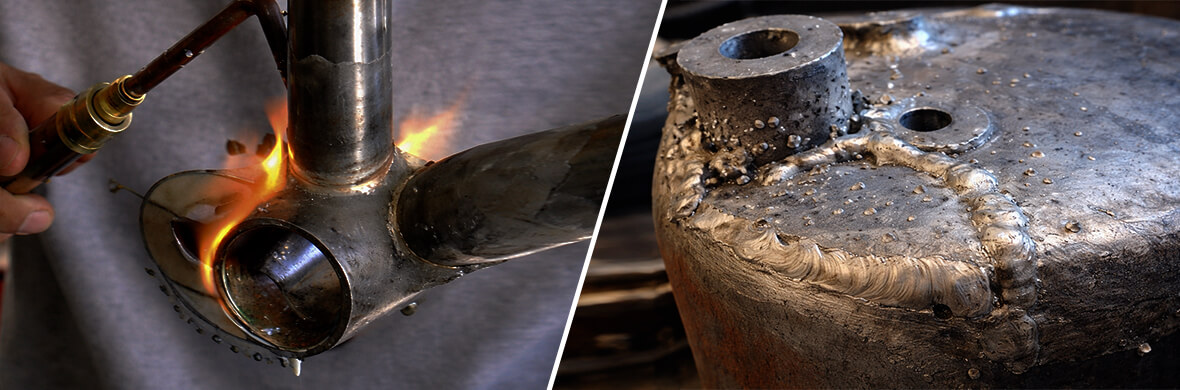
Cast iron gives welders a harder time than most materials. The carbon content is high, the material is brittle, and it reacts badly to uneven heating and cooling. Thermal gradients build up quickly, and if they’re not managed, cracking follows. In practice, almost all cast iron welding is repair work, such as getting a cracked housing, a broken section, or a worn surface back into service.
There are two ways to approach it, depending on the size and nature of the repair:
- Cold welding: Short weld runs, low heat input, minimal or no preheat. The idea is to keep thermal stress as low as possible and let the joint cool between passes. Nickel-based electrodes are used here because nickel has enough ductility to absorb the shrinkage stresses as the weld cools, rather than transmitting them into the brittle parent material as cracks.
- Hot welding: The component is preheated to 350-400°C before welding begins and cooled slowly afterward. This approach is used when a larger repair needs full fusion and structural integrity, and when the setup allows for controlled pre- and post-heat treatment.
Non-Ferrous Metals
5.1 Aluminium
Aluminium and its alloys require dedicated electrodes formulated for the high thermal conductivity and the oxide layer that forms instantly on the surface. Standard steel electrodes cannot be used.
5.2 Copper and copper alloys
Bronze and copper electrodes are used for welding copper alloys and for surfacing steel components to add wear or corrosion resistance. Thermal conductivity is high, so preheating is often needed.
6. Hardfacing Electrodes
Hardfacing electrodes are not used for joining. They are applied to surfaces exposed to wear, like abrasion, impact, erosion, heat, or combinations of these, to extend component life and reduce downtime.
Selection depends on the dominant wear mechanism:
- For abrasion, high chromium carbide deposits (around 58–65 HRC).
- For impact, tougher, crack-resistant alloys that absorb energy without chipping.
- For combined abrasion and impact, alloys that balance hardness with toughness.
Coated vs Bare Electrodes
A coated electrode does several things at once. The flux covering keeps the arc stable, throws off shielding gas as it burns, forms a slag layer over the weld pool, and plays a role in the final weld chemistry. There’s no external gas line involved, which is why stick electrodes are the practical choice for site work, maintenance jobs, and anywhere conditions aren’t controlled.
Bare electrodes depend on externally supplied flux or inert gas for shielding, where submerged arc welding and TIG are the main processes. In controlled shop environments, where higher deposition rates or tighter precision are the priority rather than portability or flexibility.
For most industrial maintenance and repair welding, coated electrodes are the more practical and reliable option.
Ador’s Industrial Welding Electrode Range
Fabrication and maintenance environments demand electrodes built for specific metallurgical conditions, not general-purpose products applied across the board.
Ador’s electrode range covers carbon steels, low and high alloy steels, stainless steels, cast iron, non-ferrous metals, and hardfacing, with each product developed for the demands of its application.
For maintenance and repair work where component life extension is the priority, Ador’s LH Alloy electrode range offers low-heat-input solutions for repair, dissimilar-metal, and hardfacing applications where conventional electrodes fall short.
FAQs
1. What are industrial welding electrodes?
Industrial welding electrodes are metal rods or wires used to carry welding current and deposit filler metal into a joint. Coated electrodes also provide arc stabilisation and weld pool protection through their flux covering.
2. How do you select the right welding electrode for different metals?
Match the electrode to the base metal composition, the required mechanical properties of the joint, the welding position, the power source, and the application conditions.
3. Which welding electrodes are commonly used for mild steel?
E6013 rutile electrodes suit general fabrication, while E7018 low-hydrogen electrodes are the standard for structural and load-bearing applications where crack resistance and toughness are required.
4. What type of electrode is used for stainless steel welding?
The electrode must match the stainless grade, E308L for 304 series, E316L for 316 series, and E309 for dissimilar metal joints between stainless and carbon steel.
5. Can the same welding electrode be used for different metals?
No. Each electrode is formulated for a specific base metal or group of metals. Using the wrong electrode leads to poor fusion, incorrect weld chemistry, and joints that fail in service.
6. What is the difference between coated and bare welding electrodes?
Coated electrodes carry a flux covering that provides arc stability and weld pool protection without external shielding. Bare electrodes rely on externally supplied flux or gas and are used in processes like SAW and TIG.
7. What industries commonly use welding electrodes?
Oil and gas, power generation, construction, shipbuilding, mining, cement, automotive, and heavy engineering all depend on industrial welding electrodes for fabrication, maintenance, and repair work.
8. Why is electrode coating important in welding?
The coating stabilises the arc, generates shielding gas to protect the molten weld pool from atmospheric contamination, controls slag formation, and influences the mechanical properties of the deposited weld metal.