Best Welding Processes for Wind Tower Maintenance
Wind turbine towers spend their entire service life under cyclic loading, constant vibration, shifting weather, and corrosive air, and that takes a toll on the steel. Maintenance welding is how operators keep that structure sound: repairing cracks, restoring corrosion-damaged sections, fixing flange defects, and rebuilding platforms, ladders, and access structures before small problems become expensive ones.
Choosing the right welding process for wind tower maintenance comes down to where the repair is located, how thick the steel is, and whether the work is done on-site or back in the shop.
Common Maintenance Issues in Wind Towers
- Fatigue cracks developing in tower shell sections after years of cyclic wind load.
- Defects at flange welds, often where stress concentrates.
- Corrosion damage, both surface pitting and deeper section loss.
- Platforms and internal ladders that need reinforcement or replacement.
- Door frames and other access structures.
- Deterioration around the base section.
- Offshore towers face the harshest of it: salt-driven corrosion and erosion.
Welding Processes Used for Wind Tower Maintenance
1. Flux-Cored Arc Welding (FCAW)
A high-deposition process built for productivity, and in its self-shielded form, the most dependable choice for repairs out in the field.
Applications:
- Tower shell repairs across longitudinal and circumferential zones.
- Flange repairs that demand solid joint strength.
- Structural reinforcement of load-bearing sections.
- Crack repair in a thick plate, where a high deposition rate pays off.
The self-shielded variant (FCAW-S) is the reason this process dominates field repairs. It generates its own shielding from the flux core, so gusty conditions up the tower don’t disperse the gas the way they would with a process that relies on an external supply. Gas-shielded FCAW-G stays in the workshop.
2. Manual Metal Arc Welding (MMAW/SMAW)
The most portable option of the lot, ideal for remote and awkward-access repairs where heavy equipment can’t follow.
Applications:
- General site repairs.
- Remote maintenance work where bringing equipment up is difficult.
- Tight, access-restricted areas inside the tower.
- Structural root passes on field joints.
MMAW earns its place through sheer portability. No shielding gas, minimal kit, and it tolerates rough site conditions, which is exactly what you want halfway up a tower in a remote wind farm.
3. Gas Metal Arc Welding (GMAW/MIG-MAG)
A fast, clean process that does its best work in the controlled conditions of a workshop.
Applications:
- Workshop-based repairs.
- Fabrication modifications.
- Internal tower component repairs in controlled conditions.
One limitation matters here: GMAW depends on an external shielding gas, and wind blows that gas away. That rules it out for exposed outdoor work and keeps it firmly in shop or sheltered settings, where it delivers clean, fast welds.
4. Submerged Arc Welding (SAW)
The deep-penetration workhorse for shop refurbishment of thick tower sections and long seams.
Applications:
- Major refurbishment projects.
- Shop-based repairs of full tower sections.
- Circumferential seam repairs on rolled shells.
SAW is the high-deposition workhorse for shop refurbishment. The submerged flux gives deep, consistent penetration on thick sections, though it needs the flat, positioned setup only a workshop provides.
5. TIG Welding (GTAW)
This precision welding process is reserved for thin-wall joints, stainless components, and where weld quality can’t be compromised.
Applications:
- Precision repairs where weld quality is critical.
- Root passes on thin-wall and stainless joints.
- Instrumentation mounts and stainless-steel components.
TIG handles the fine, clean work. Where MMAW lays a structural root on heavy field joints, TIG is the choice for thin material, stainless parts, and anything where appearance and integrity both count.
Critical Welding Considerations
Low-Hydrogen Practices
Tower shells are usually built from high-strength structural steel, commonly S355 grade, and that steel is prone to hydrogen-induced cold cracking. Keeping hydrogen out of the weld is non-negotiable. In practice, that means:
- Using low-hydrogen consumables.
- Baking and storing basic electrodes properly so they never pick up moisture.
- Applying the right preheat for the steel grade and thickness.
- Holding the interpass temperature within the procedure window.
Thermal Spray Coatings (TWIN Arc & HVOF)
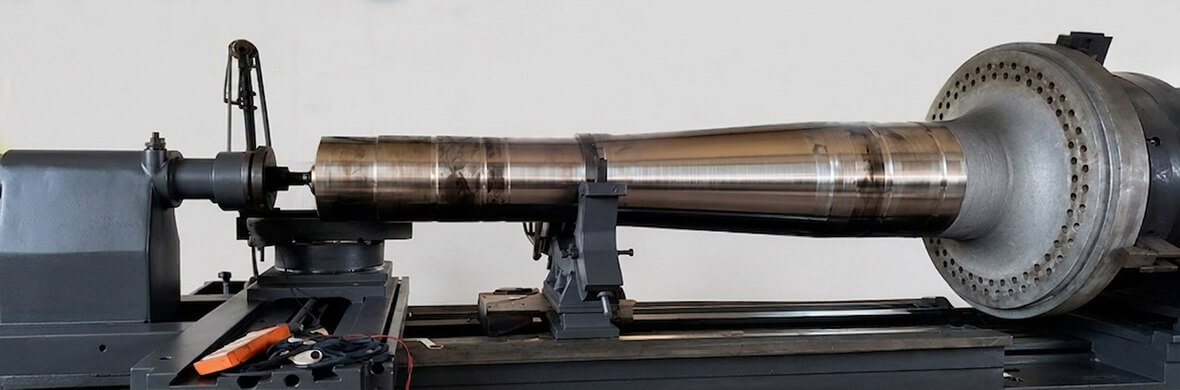
Worth noting separately, because these are coating methods, not welding. HVOF and twin-wire arc spray rebuild worn surfaces and add wear or corrosion resistance rather than fusing a joint. They come into play during major refurbishment, typically for restoring worn rotating components such as shafts, and extend service life where simple weld repair won’t do the job.
Process Selection Guide
| Maintenance Activity | Preferred Process |
|---|---|
| Crack repair | FCAW/MMAW |
| Flange repair | FCAW |
| Structural reinforcement | FCAW/GMAW (shop) |
| Precision component repair | TIG |
| Shop-based seam refurbishment | SAW |
| Worn-surface restoration (coating) | HVOF/Twin-wire arc spray |
| Remote site maintenance | MMAW |
Benefits of Proper Welding Maintenance
- Tower service life stretches well beyond what neglected structures manage.
- Structural reliability improves across the whole assembly.
- Fewer unplanned shutdowns, which is where the real cost sits.
- Cracks get caught before they propagate into something serious.
- Maintenance budgets come down over time.
- Turbine availability rises, and so does energy output.
Conclusion
For wind tower maintenance, FCAW is generally the go-to process, thanks to its high productivity and, in its self-shielded form, its reliability in open field conditions. MMAW stays valuable for remote and access-restricted repairs, while GMAW, SAW, and TIG each earn their place based on accessibility, section thickness, and quality requirements.
HVOF and twin-wire arc spray work in tandem with various welding processes, mainly for rebuilding worn rotating parts during a major refurbishment.
Get the process right, back it with low-hydrogen consumables and proper procedures, inspect the work thoroughly, and the repair will last for a long time.