FCAW vs GMAW: Which Is Better for Productivity?
The choice of welding process can have a significant impact on productivity, quality, and overall fabrication costs. Real productivity is about arc-on time, weld completion speed, rework, consumable costs, joint preparation requirements, and the ability to weld under real-world conditions.
Flux-cored arc welding (FCAW) and gas metal arc welding (GMAW) can both lay down high-quality welds, but their productivity advantages depend heavily on the application.
FCAW vs GMAW
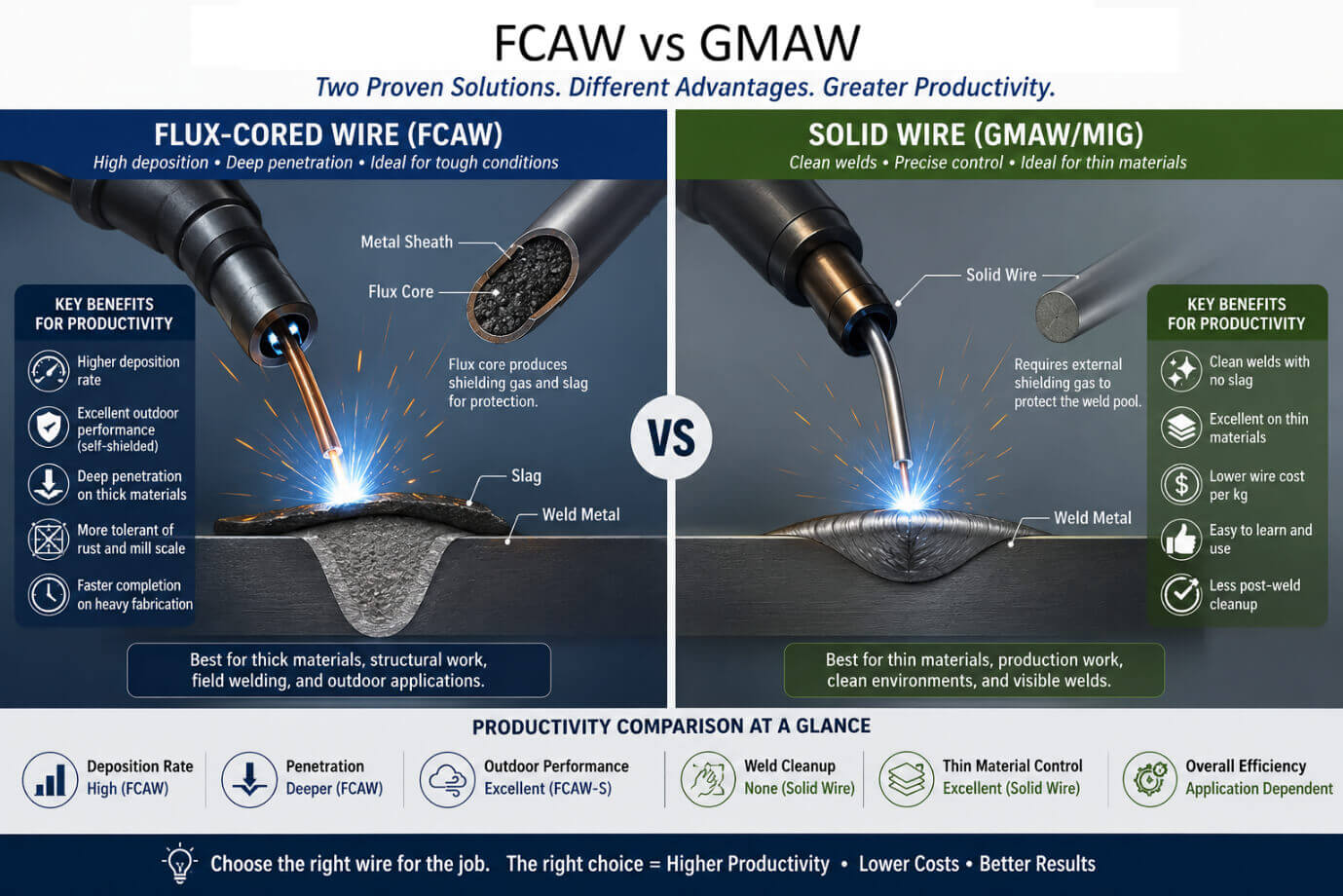
GMAW, for solid wire carbon steel, uses an external shielding gas such as 75% Argon or 25% CO₂. It is widely used in fabrication shops, automotive applications, and thin-gauge welding because it produces clean welds with minimal spatter and no slag.
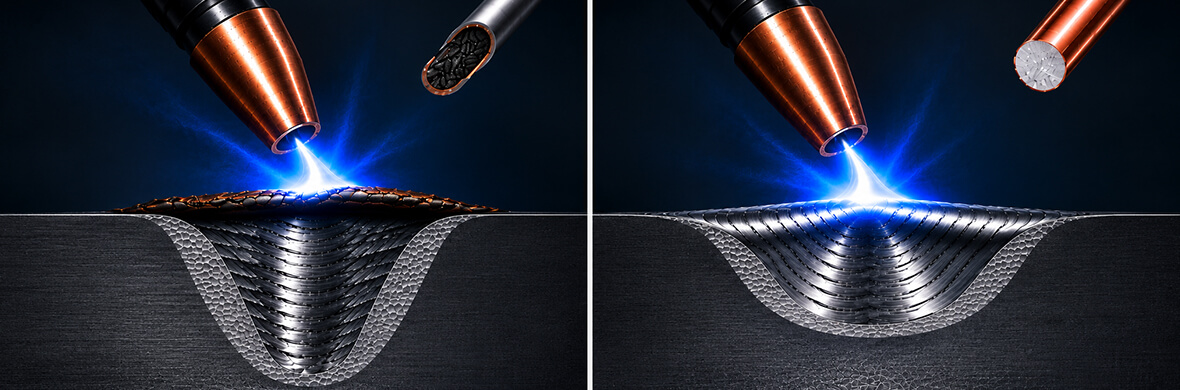
Flux-cored arc welding, on the other hand, contains flux within a tubular wire. It may be self-shielded (FCAW-S) or gas-shielded (FCAW-G), and is often preferred for structural fabrication, outdoor welding, and heavy-section applications.
Productivity Starts with Deposition Rate
Deposition rate, the amount of weld metal deposited per hour, is a key productivity metric.
Industry data shows that gas-shielded flux-cored wire (FCAW-G) typically achieves higher deposition rates than solid wire:
- Solid wire: 2.8–4.0 kg/h
- Gas-shielded FCAW: 4–6 kg/h
- Automated FCAW: even higher
Studies report productivity gains of 15–40% or more when flux-cored arc welding replaces gas metal arc welding in structural fabrication. The tubular design of flux cored wire supports higher current densities and faster metal transfer, resulting in shorter welding times and increased throughput, particularly on thick sections and large fillet welds.
Welding Efficiency Beyond Deposition
Productivity depends on more than deposition rate. Preparation, welding, and cleanup time also affect overall efficiency. GMAW offers several benefits:
- No slag removal
- Lower wire cost
- Clean weld appearance
- Welding on thin materials
For applications such as sheet metal fabrication, automotive components, and general manufacturing, minimal cleanup helps streamline production. Although FCAW requires slag removal, its higher deposition rate and faster travel speeds often offset the additional cleanup effort, especially on thicker materials.
Productivity in Real-World Conditions
Welding conditions can significantly impact productivity. Because GMAW relies on external shielding gas, wind and drafts can cause porosity and require additional protection measures.
Self-shielded flux-cored generates its own shielding atmosphere, making it well suited for:
- Construction sites
- Shipyards
- Agricultural repairs
- Bridge fabrication
By eliminating gas cylinders and reducing sensitivity to wind, FCAW can improve productivity.
Performance on Thick and Dirty Materials
FCAW is preferred for thicker materials or surfaces with light contamination. Its flux system contains deoxidizing elements that help manage rust, mill scale, and other surface contaminants.
Key advantages include deep penetration, strong sidewall fusion, and better performance on thick sections. These characteristics can reduce the number of welding passes and help minimize repair work, contributing to higher overall productivity.
Productivity Comparison
| Factor | GMAW/MIG | FCAW |
|---|---|---|
| Deposition Rate | Moderate | High to Very High |
| Arc-On Productivity | Good | Excellent |
| Thin Material Welding | Excellent | Moderate to Good |
| Thick Material Welding | Good | Excellent |
| Outdoor Performance | Poor to Moderate | Excellent (FCAW-S) |
| Slag Removal | None | Required |
| Weld Cleanup Time | Minimal | Higher |
| Tolerance to Rust/Mill Scale | Limited | Better |
| Equipment Portability | Lower (gas required) | Higher (FCAW-S) |
| Overall Productivity on Heavy Fabrication | Moderate | High |
Conclusion
The most productive choice is not the same for every job. For heavy fabrication, flux-cored arc welding typically provides the greatest throughput. For precision fabrication and thin-gauge work, gas metal arc welding is the more efficient solution.