How Flux Core Welding Improves Productivity in Manufacturing Industries
Welding plays a critical role in manufacturing industries such as heavy engineering, construction equipment, shipbuilding, cement plants, automotive, pressure vessels, and structural fabrication. Among various welding processes, Flux Cored Arc Welding (FCAW) has become one of the most preferred methods for improving productivity due to its high deposition rate, faster welding speed, and ability to weld in challenging environments.
Flux core welding combines the advantages of shielded metal arc welding and gas metal arc welding, making it highly efficient for industrial applications.
What is Flux Core Welding?
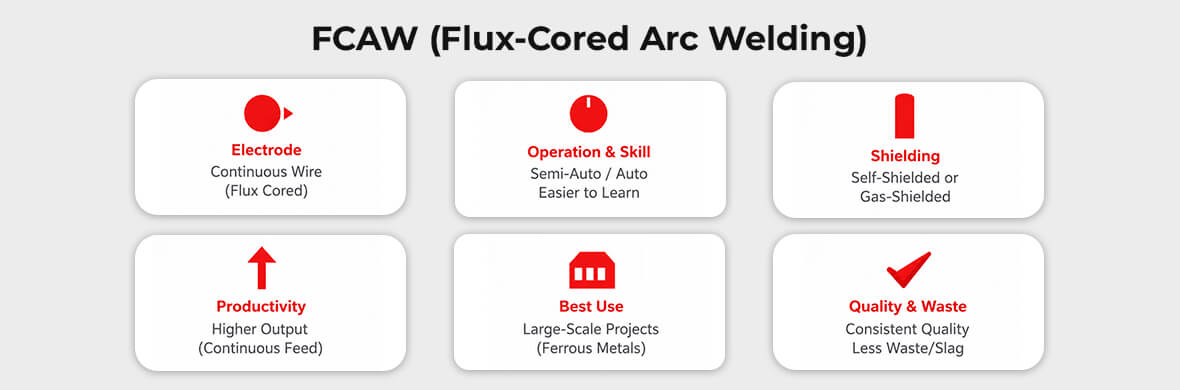
Flux Core Arc Welding (FCAW) is a semi-automatic or automatic arc welding process that uses a continuously fed tubular wire filled with flux. The process generates heat through an electric arc between the workpiece and the consumable electrode wire.
There are two major types:
-
Self-Shielded FCAW (FCAW-S)
Flux inside the wire produces shielding gases during welding.
-
Gas-Shielded FCAW (FCAW-G)
Uses external shielding gas along with flux-cored wire.
Key Productivity Advantages of Flux Core Welding
1. Higher Deposition Rate
One of the biggest productivity benefits of FCAW is its high metal deposition rate compared to traditional welding processes like Shielded Metal Arc Welding (SMAW).
Typical deposition rates:
| Welding Process | Deposition Rate |
|---|---|
| SMAW | 1–5 kg/hr |
| GTAW/TIG | 1–3 kg/hr |
| FCAW | 5–12 kg/hr |
Benefits
- Faster weld completion
- Reduced production cycle time
- Increased output per shift
This is especially beneficial in:
- Structural steel fabrication
- Cement plant equipment repairs
- Heavy machinery manufacturing
- Pressure vessel fabrication
2. Faster Welding Speed
Flux core welding supports higher travel speeds while maintaining excellent weld quality.
Productivity Impact
- Shorter fabrication timelines
- Reduced labor hours
- Higher equipment utilization
In manufacturing environments where deadlines are critical, FCAW significantly improves throughput.
3. Reduced Downtime
Unlike stick welding, FCAW uses continuous wire feed, reducing interruptions caused by:
- Electrode changing
- Slag cleaning
- Frequent restarts
Result
- Continuous welding operation
- Better arc efficiency
- Improved welder productivity
This is highly valuable in automated and semi-automated production lines.
4. Better Penetration and Strong Welds
FCAW offers:
- Deep penetration
- Good fusion characteristics
- High mechanical strength
This reduces the need for:
- Multiple weld passes
- Extensive joint preparation
- Rework due to defects
Productivity Gain
Lower repair and rejection rates improve overall manufacturing efficiency.
5. Capability to Weld Thick Sections
Flux core welding is ideal for medium and thick-section materials commonly used in:
- Kiln tyres
- Support rollers
- Heavy shafts
- Structural beams
- Crusher components
Benefits
- Faster filling of large joints
- Reduced welding time
- Lower heat input compared to multiple SMAW passes
6. Easier Automation and Mechanization
FCAW integrates effectively with:
- Robotic welding systems
- Column and boom setups
- Automatic welding manipulators
Manufacturing Advantages
- Consistent weld quality
- Reduced human error
- Increased repeatability
- 24/7 production capability
Automation greatly enhances productivity in mass manufacturing industries.
Conclusion
Flux Cored Arc Welding (FCAW) has become a preferred welding process in manufacturing industries because of its ability to deliver:
- High deposition rates
- Faster welding speeds
- Reduced downtime
- Better weld quality
- Improved automation capability
For industries focused on improving operational efficiency and reducing production costs, FCAW offers a practical and highly productive welding solution. It is especially valuable in heavy fabrication, maintenance shutdowns, structural manufacturing, and repair applications where speed, strength, and reliability are critical.