Welding Solutions for Railway Track Maintenance
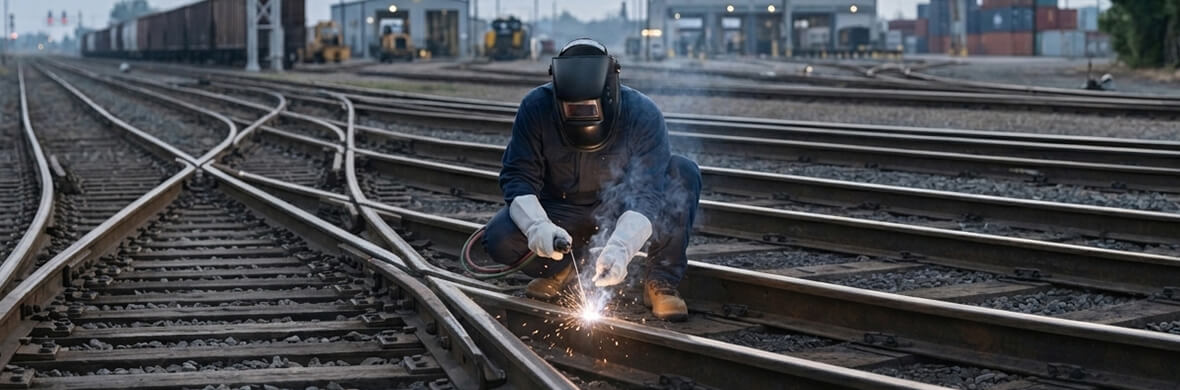
Railway tracks take a relentless beating: continuous axle loads, wheel impact, friction, and weather all working against the steel until you see wear, cracks, deformation, and metal loss. Welding is what brings that track back to spec.
Done right, railway track welding restores integrity, stretches rail life, trims maintenance spend, and keeps the line running safely.
Common Railway Track Problems
- Wear on the rail head from constant wheel contact.
- Surface defects and corrugation that roughen the running profile.
- Cracks forming in rails and at crossings.
- Joint failures along bolted or welded connections.
- Metal loss where abrasion grinds the steel down.
- Damage in switches and crossings, the high-stress S&C zones.
- Impact wear concentrated at frogs and crossing noses.
Welding Applications in Railway Track Maintenance
1. Rail Joint Welding
Rail joints are welded into continuous welded rail (CWR), which cuts the impact loads that bolted joints create and gives a smoother ride.
Methods:
- Thermite (aluminothermic) welding for in-track field joints.
- Flash butt welding for new rail and depot work.
The two methods aren’t interchangeable. Thermite goes wherever the track runs, which is why it handles most in-track field joints, while flash butt lays down a cleaner, stronger weld with far less added metal, but needs the rail brought to the machine, so it stays in depots and new-build work.
One thing to keep in the front of mind: a joint weld here is safety-critical. Get it wrong, and you’re looking at a derailment risk, so weld quality and inspection carry real weight.
Benefits:
- A smooth, uninterrupted rail profile.
- Less routine maintenance over the rail’s life.
- Better track stability under load.
- Noticeably lower noise and vibration.
2. Rail Head Rebuilding
The rail head wears continuously where the wheel rides it, and rebuilding restores that worn surface rather than replacing the whole rail.
Repair Process:
- Inspect the rail and pinpoint the defect.
- Prepare and grind the surface clean.
- Lay down build-up welding to restore lost material.
- Grind back to the correct profile.
Recommended Consumables:
- Low-alloy build-up electrodes.
- Flux-cored hardfacing wires.
- Wear-resistant alloy deposits.
Rail is high-carbon pearlitic steel, and that makes it touchy to weld. By skipping preheating or letting it cool too fast, you get hard, brittle martensite forming in the heat-affected zone, which is how repair welds crack.
So the rule is preheat before you build up, and bring the temperature down slowly afterwards. Ador’s low-alloy build-up electrodes are made for exactly this kind of controlled rail-head restoration.
Advantages:
- Brings the rail back to its original profile.
- Adds years to rail service life.
- Cuts the cost of full rail replacement.
3. Switches and Crossings (S&C) Refurbishment
Switches, frogs, and crossings cop the worst of the impact and abrasion on any track, so they need attention more often.
Typical Repairs:
- Removing existing cracks.
- Build-up welding to replace lost section.
- Laying a hardfacing overlay for wear resistance.
- Restoring the running profile.
Preferred Processes:
- MMAW (Manual Metal Arc Welding).
- FCAW (Flux-Cored Arc Welding).
- Automated hardfacing systems for repeatable, high-volume work.
Many S&C components are cast in austenitic manganese steel, the Hadfield grade, which hardens under wheel impact but becomes difficult the moment you bring heat to it.
Too much heat triggers carbide precipitation and embrittlement, so the steel has to stay cool through the weld: low interpass temperature, short stringer beads, and quick cooling between passes.
It’s the exact opposite of rail steel, which wants preheat. That contrast is why S&C work demands its own procedure and consumables.
4. Crack Repair Welding
Cracks turn up for a handful of reasons:
- Fatigue from repeated loading.
- Thermal stress through temperature swings.
- Defects left over from manufacturing.
- Damage from impact events.
Repair Procedure:
- Confirm the crack with non-destructive testing, usually UT and MT.
- Excavate the cracked metal back to sound material.
- Weld the repair under controlled conditions.
- Grind, then re-inspect to confirm the fix.
A word of caution: not every crack is a welding job.
Surface cracks and shallow defects clean out and repair fine, but a transverse defect buried in the rail head, or a crack past the size the standard allows, means the rail comes out. Trying to weld over that kind of damage hides the problem instead of fixing it, which is why the inspection step at the start matters as much as the welding that follows.
5. Hardfacing of High-Wear Areas
Hardfacing lays a tough, wear-resistant layer over the components that take the most punishment, and it makes a real difference to how long they last.
Components Protected:
- Rail crossings.
- Frogs at the crossing nose.
- Switch points.
- Guard rails running alongside.
What makes hardfacing work is matching the alloy to the kind of wear it’s facing. Chromium carbide deposits stand up to severe sliding abrasion, while austenitic manganese overlays suit the high-impact zones like frogs and crossing noses, where the surface needs to take a beating and harden as it goes.
Put the wrong alloy on the wrong component, and the overlay wears out early, so consumable choice is half the job here.
Benefits:
- Longer service life before the next intervention.
- Maintenance crews called out less often.
- Better overall track availability.
Recommended Welding Processes
| Process | Application |
|---|---|
| Thermite welding | Rail joining in field conditions. |
| Flash butt welding | New rail installation and depot work. |
| MMAW | General repair welding. |
| FCAW | High-productivity rebuilding and hardfacing. |
| GTAW/TIG | Precision repairs on special components. |
| Automated hardfacing | Switches and crossings refurbishment. |
Typical Welding Consumables
The consumable you reach for depends on what the repair actually has to do: rebuild lost section, stand up to wear, or join metal that doesn’t weld easily. That’s how the choices break down.
Build-Up Consumables
These restore material that’s worn or been ground away.
- Low-hydrogen electrodes.
- Low-alloy repair electrodes.
- FCAW build-up wires.
Hardfacing Consumables
These add a wear-resistant layer over the surfaces that take the most punishment, and the right one comes down to the kind of wear.
- Chromium carbide alloys for severe abrasion.
- Manganese steel electrodes.
- Martensitic hardfacing wires.
- Austenitic manganese consumables suited to work-hardening components.
Special Consumables
These handle the awkward repairs that standard electrodes can’t.
- Nickel-based electrodes for difficult-to-weld and dissimilar repairs.
- Stainless steel buffer layer consumables.
A note on storage: low-hydrogen electrodes only stay low-hydrogen if they’re kept that way. Store them sealed, and re-bake them to the maker’s spec before use, because once they pick up moisture from the air, the hydrogen goes straight into your weld and the cracking risk you were trying to avoid comes right back.
Quality Control Requirements
- Visual inspection of every repair.
- Ultrasonic Testing (UT) for embedded defects.
- Magnetic Particle Testing (MT) to catch surface cracks.
- Rail profile measurement against spec.
- Hardness testing on the deposited metal.
- Dimensional verification before the track returns to service.
Benefits of Welding-Based Track Maintenance
- Rails, switches, and crossings stay in service far longer.
- Replacement costs drop across the asset base.
- Track possession time shrinks, which keeps trains moving.
- Operational safety improves where it counts.
- Track reliability climbs.
- Lifecycle maintenance costs come down year on year.
- More of the railway’s assets stay available for use.
Railway Compliance
The Research Designs and Standards Organisation (RDSO) is the premier research, design, testing, and standards body of Indian Railways. It works under the Ministry of Railways and is headquartered in Lucknow.
RDSO sets the specifications and standards for railway materials, components, equipment, and infrastructure, and it approves the welding procedures, consumables, and repair methods used across Indian Railways.
Value Delivered
A well-planned railway track welding programme can add several years to the working life of rails, switches, and crossings while cutting both downtime and replacement costs. Ador manufactures RDSO-approved consumables, including electrodes and wires built specifically for track repair work.
Backed by modern hardfacing and repair welding technology, Ador helps railway operators keep their track infrastructure safe, reliable, and cost-effective over the long haul.